

Wye
This is an attractive rural station, which retains much of its bygone charm. The site has managed to avoid drastic rationalisation and modernisation – until comparatively recently, not only did the station boast 19th Century buildings and manually-operated level crossing gates, but also comprised a working signal box and a full complement of semaphores.
The Ashford to Canterbury section of the SER’s branch to Margate came into use for scheduled passenger traffic on 6th February 1846, but a station at Wye opened later in that same year, on 1st July. The SER had received Royal Assent for its Thanet via Canterbury line on 23rd May 1844, and secured £400,000 in shares and £133,000 in the form of loans to cover the route’s construction cost.
Two platforms came into use, lined at their rears with iron railings, and contrary to SER practice at the time – particularly at rural sites – these were not staggered. The main building was a somewhat grand affair, positioned at the southern end of the ‘’up’’ platform. It was two-storeys high, built in red brick, lined at the edges with stone, and demonstrated a series of gabled pitched roof sections. Of those stations upon the Ashford to Minster (exclusive) section of line, only Wye and Grove Ferry boasted such elaborate structures, each being a slight variation of a standard design. A scaled-down version of this same architecture was used for Crossing Keepers’ houses at both of these sites, and at the latterly opened Chartham. The level crossing at Wye was located immediately south of the platforms, and was flanked to the west and east by the aforementioned Keeper’s house and a gate box respectively. With reference to the latter, this was a diminutive single-storey clapboard affair, comprising a slated pitched roof and the SER’s trademark sash-style windows. It is likely that this came into use during the mid-1860s as the station’s first signal box, at a time when signalling nationwide was still in its primitive stages. More clapboard was also to be seen upon the ‘’down’’ platform, where an attractive 30-foot-long waiting shelter, complete with wrap-a-round sides, windows, and a backward-sloping roof, was provided.
In the latter part of the 19th Century, the SER hired contractors Saxby & Farmer to re-signal a number of its station sites. This was at a time when re-signalling projects had become so vast in number, the SER was unable to undertake all the work in-house. Saxby & Farmer modernised signalling arrangements at Grove Ferry, Sturry, Chilham, and Wye stations, and this probably coincided with the company’s partial re-signalling of the SER’s Ashford to Hastings line, in 1893. Signal box design along both routes was standardised on an attractive gabled-roof structure, comprising a brick base and timber upper half. The cabin at Wye was built at the northern end of the ‘’up’’ platform, providing the signalman with a clear view over the layout’s sidings. With reference to the latter, goods facilities eventually comprised four lengthy sidings to the north of the platforms, in addition to a northward-facing dock line used for loading cattle into wagons. One of the four sidings terminated behind the ‘’down’’ platform, serving a goods crane and a pair of coal staithes to its immediate west.
Before moving on, it is worth mentioning, if only briefly, Wye Racecourse. This had come into being, initially for flat racing, in 1849, the first meeting being held on 29th May of that year. Steeplechases were held in September, January, March, and May, and the oval course, less than a mile in length, was located 600 yards south of the station. At SER site, a third platform surface, dedicated to race day passenger traffic, was provided, immediately south of the level crossing. The racecourse track was to be found on the ‘’down’’ (west) side of the line, but conversely, the racecourse platform was built on the ‘’up’’ side of the line. Beside the ‘’down’’ track existed the Crossing Keeper’s residence and a ‘’home’’ semaphore, whilst the land alongside the ‘’up’’ track was without any significant obstacle, perhaps explaining the location choice of the third platform.
The Southern Railway installed its trademark swan-neck lampposts, complete with ‘’Target’’ name signs, but little else changed at Wye under this company’s reign. It was the British Railways era, particularly the period of the Kent Coast Electrification Scheme, which brought moderate infrastructure alterations. These began in 1960, with the installation of a 50-foot-span prefabricated concrete footbridge – a product of Exmouth Junction Works – between the platforms. This required the fitting of a banner repeater signal to the ‘’up’’ platform, now that the footbridge obscured the starter semaphore at the southern end of the layout. The platform surfaces themselves were re-faced with the same material, and the wrought-iron swan neck gasp lamps gave way to electric lighting, supported upon concrete bracket posts and demonstrating hexagonal lampshades. A regular electric service along the route commenced on 9th October 1961, but the full accelerated timetable on the ex-SER trunk line did not come into use until 18th June of the following year. Modernised colour light installations, controlled from a series of ‘’power boxes’’, came into use during the electrification programme on both Chatham and Tonbridge main lines, but the mechanical signalling of the Ashford to Hastings, Ashford to Minster, and Faversham to Dover Priory routes remained unaltered. Thus, Wye retained its Saxby & Farmer cabin, which continued to control a splendid array of semaphores, in addition to the sidings of the goods yard; the latter were formally decommissioned on 10th June 1963.
In about 1990, the distinctive concrete bracket lampposts were replaced by modern metal variants, and digital clock displays appeared on the platforms. At this time, traditional level crossing gates remained and these continued to be worked by hand. A lever frame was present at the southern end of the ‘’down’’ platform, which was used by the Crossing Keeper to release the gates. Semaphore signals were a feature of the station right up until the end of 2003: on 15th December of that year, colour aspect lights were commissioned in the vicinity, controlled from the ‘’Canterbury Wye Area Control Centre’’. The latter can be found at Canterbury West, in a modern portacabin affair located next to the gantry of the 1928-erected signal box. The Saxby & Farmer cabin at Wye was switched out of use, whilst the SER-designed signal box at Chartham was relegated to a gate box.


20th April 2007

An Ashford-bound view from the ''down'' platform shows the prefabricated concrete footbridge of 1960 and the architectural splendour of the main ''up'' side building. In the background, beyond the level crossing, can be seen the overgrown site of the former racecourse platform. This was a shallow affair, more akin to the ground-level platforms found on the Continent. The last race at Wye took place on 2nd May 1974. © David Glasspool
20th April 2007

A second southward view, this time from the footbridge, shows the delightful ''down'' side clapboard waiting shelter. Between this and the level crossing, at the bottom of the platform ramp, is the lever frame which is used to release the crossing gates. Just to the right of the gates is the whitewashed Crossing Keeper's house. © David Glasspool
20th April 2007
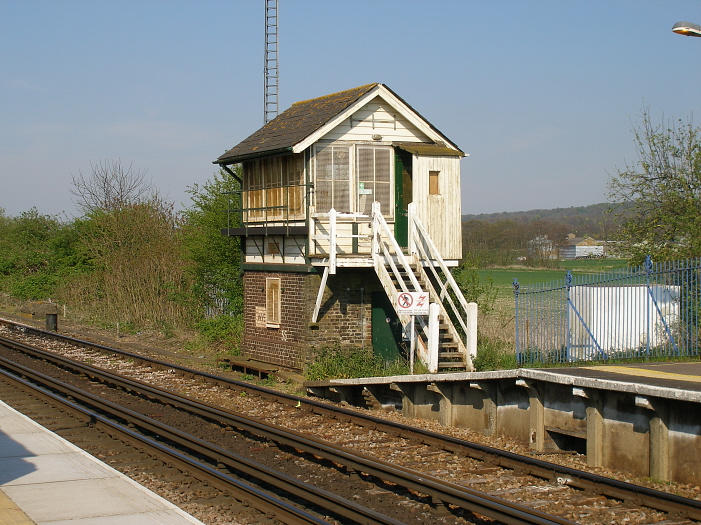
After the change over to colour aspect lights, the windows of the vintage Saxby & Farmer signal box were fitted with mesh panels, as a precaution against vandalism. Note the gap in platform side, from where point rodding once emerged for a trailing crossover (see track plan). © David Glasspool
Return to the Kent Rail Homepage or alternatively, check for Updates.
Website & Copyright information - Links - Contact the Webmaster