

Vauxhall
Vauxhall – the first station out of Waterloo. The London & Southampton Railway opened its first section of line between the capital and Woking Common on 21st May 1838. Through running all the way to Southampton was possible from 11th May 1840, and from the outset, the line terminated at its eastern end at Nine Elms. On 31st July 1845, the "Metropolitan Extension Act" acquired Royal Assent, which involved extending the Southampton route by nearly 2¾-miles in an easterly direction, to a new site at York Road, on the southern sides of Waterloo and Hungerford Bridges. Works were expensive, and the sheer cost of the extension was difficult to justify, in light of projected traffic growth. Nevertheless, the LSWR was authorised to raise a capital of £739,180 (£59,644,333 at 2008 prices), take out loans amounting to £233,000 (£18,800,738 at 2008 prices), although the total expense was estimated at £800,000. In the 1846 Parliamentary Session, the LSWR also applied for a further 1¼-mile extension from Waterloo Bridge to a site adjacent to the Thames near London Bridge, and the Commissioners recommended this for approval on 27th June 1846.
- Metropolitan Extension No. 1: Nine Elms to Waterloo Bridge
- Metropolitan Extension No. 2: Waterloo Bridge to London Bridge
In July 1846, construction of the Nine Elms to Waterloo Bridge extension began. Joseph Locke was appointed engineer of this section, having earlier produced the company’s Southampton main line, and building work was subcontracted to Messrs. Lee. The proposed line comprised four tracks, this then large number being justified on the grounds of future traffic growth and the possibility of leasing rails out to other companies. For the first ¼-mile east from Nine Elms, the line was carried on an embankment; thereafter, the rest was laid upon a huge viaduct. The latter comprised six enormous iron girder bridges, with a combined weight of 800 tons, in addition to 300 arches (excluding those beneath the Waterloo Bridge terminus). The entire extension used no less than 80,000,000 bricks. The viaduct arches were covered with "Seyssel Asphalt", making them completely waterproof and thus ideal for business use; the latter was hoped to be a large source of revenue. The iron rails of the four-track layout accounted for a weight of around 1200 tons.
The Waterloo Bridge extension opened on 11th July 1848, Vauxhall coming into use at this time. On opening, it was stated that both Waterloo Bridge and Vauxhall stations were only temporary affairs, awaiting later development to take on "proper" forms. Metropolitan Extension No. 2, that to London Bridge, was still in the pipeline, precluding significant development at Waterloo until its completion. Sir William Tite, perhaps best know for his work west of Salisbury, had produced the first station at Vauxhall. This was wholly timber in construction, economising on both weight and cost. Temporary it was indeed, for the first station disappeared in unexpected and spectacular style: a fire broke out in April 1856, destroying all existing station structures and requiring the temporary re-opening of Nine Elms to passengers on 13th of that month. By this time, the London Bridge scheme had been dropped, primarily due to the expense of buying the required land.
Since the fire of 1856, a four-platform layout was maintained at Vauxhall, serving tracks of equal number. The station comprised a centrally-located island in-between the middle tracks, whilst the outer lines were served by platforms elevated upon cast-iron struts along the sides of the viaduct. The booking hall and waiting rooms were all to be found at street level.
The rather ramshackle affair at Waterloo Bridge continued to grow, and more platforms were commissioned on the station’s southern side in December 1878. Then, in November 1885, an almost standalone station was opened on the northern extremity of the site, to serve the Windsor lines, and the terminus now commanded sixteen platform lines converging on a quadruple track approach. To relieve this bottleneck, a widening scheme was begun in 1886, which sought to create a six-track line between Waterloo Bridge and Nine Elms. In 1890 the LSWR agreed to re-home over 1000 people in the Vauxhall area, who were displaced as a result of the works. Two years later, in 1892, the station at Vauxhall was wholly rebuilt, providing six platform faces arranged in the form of three islands. The western-most island was the longest of them all, measuring 830-feet in length and comprising a 345-foot-long canopy. The latter was built to an attractive triangular design, complete with an ornate spiked canopy valance, all supported upon a cast-iron framework. The central island stretched for 740-feet and was host to a 365-foot-long canopy; the eastern-most island was of the same dimensions. Although there were six platform faces in total, there were in fact seven running lines, the western and central islands being separated by a triple-track formation. As was common at suburban stations in elevated positions, space-saving signal boxes, suspended above the tracks, were commissioned. At northern and southern ends of Vauxhall came into use structures of this ilk: a pair of timber signal cabins were carried across five of the seven running lines upon lattice gantries. Signalling contractors "Stevens & Sons" were used extensively during the widening of the approaches.
From the outset, Vauxhall’s primary role was that of a ticket collecting station. London-bound trains would stop here before reaching Waterloo Bridge, and a swarm of inspectors would board each separate carriage compartment to check tickets. This practice was latterly phased out as gangway corridor stock became common, and ticket barriers appeared at the terminus. On its western elevation, Vauxhall was characterised by a high yellow brick wall, which extended upwards from the top of the viaduct arches and blocked the view of the platforms from the below road. Similar architectural features were incorporated into the LC&DR’s Elephant & Castle, and needless to say, the wall dwarfed the small station building at the LSWR site. This was a quaint structure, rising up no higher than the viaduct arches, at 55-feet-long by 15-feet deep. A stone exterior was frescoed by a series of identical arches, those at the outer limits being fitted with porch canopies. The main building was constructed approximately mid-way down the station’s western elevation, and through the ticket office a spacious subway – formed from a series of viaduct arches – linked the islands through flights of stairs. Naturally, Vauxhall was host to no visible goods facilities, but the station nevertheless handled very large quantities of milk traffic, churns arriving here from dairy depots based deep in the West Country.
When one looks back in history, dates of events and alterations seem to vary, depending on where one looks, and the background to Vauxhall is no exception. However, it is clear that by the turn of the century, the station comprised seven through lines, as per the rebuilding of 1892. Further widening was due when, in 1913, the LSWR started work on its first electrification scheme. A 600-Volt D.C. third rail system was selected, and it was intended to eventually treat the three main routes leading to Guildford, via Claygate, Epsom, and the main line at Woking. In addition, the Kingston and Hounslow Loops, Hampton Court and Shepperton branches were to be similarly treated. Between Waterloo and Loco Junction (Nine Elms), the number of running lines was to be increased from six to eight. The viaduct was widened on its southern side, and at Vauxhall a further two tracks and another platform face were brought into use. Thus, the latest widening had produced a layout of seven platform faces and nine tracks, all electrified. The seventh platform face lined the eastern perimeter of the viaduct, and was separated from the eastern-most island by a triple-track, this formation having existed between western and central islands since 1892. Electric services commenced as follows:
- Waterloo to Wimbledon via East Putney: 25th October 1915
- Kingston Loop and Shepperton branch: 30th January 1916
- Hounslow Loop: 12th March 1916
- Hampton Court branch: 18th June 1916
- Surbiton to Claygate: 20th November 1916
The Southern Railway was swift in expanding the range of the electric network. Third rail was extended to Guildford and Dorking North, the first celebratory electric service travelling to both locations on 9th July 1925. Full public services commenced on 12th of the same month. The Windsor Line formally switched over to electric operation on 6th July 1930, and a half-hourly service was maintained on the route in each direction during the off-peak. In the peak hours, this frequency was increased to one train every twenty minutes. At this time, the layout at Vauxhall was arranged as follows, from east to west:
|
Vauxhall: 1892 Arrangement |
|
SIDE PLATFORM |
| "Down" Main Local |
| "Down" Main Through |
| "Up" Main Relief |
| ISLAND PLATFORM |
| "Up" Main Local |
| "Up" Main Through |
| ISLAND PLATFORM |
| "Down" Windsor Local |
| "Down" Windsor Through |
| "Up" Windsor Through |
| ISLAND PLATFORM |
| "Up" Windsor Local |
Electrification brought faster, more frequent services, but trouble was brewing at Waterloo. Of the terminus’ 21 platforms, Nos. 1 to 6 and 16 to 21 were electrified. The mechanical signalling, working on Sykes Lock-and-Block control and dating from the 1892 widening, could route each of the eight approach lines into virtually any platform. To reach platform Nos. 1 to 6, electric services were required to approach Waterloo on the "Up" Main Relief and subsequently cross the "Down" Main Through. Naturally, conflicting movements on the level caused inevitable delays and in January 1935, the Southern Railway unveiled a £500,000 scheme (£25,871,242 at 2008 prices) to re-signal the Waterloo approaches. Between Clapham Junction and Vauxhall, the tracks were to be re-arranged as follows, from north to south:
|
1892 Layout |
Proposed 1936 Layout |
|
''Up'' Windsor |
''Up'' Windsor Local |
| ''Down'' Windsor Through | ''Up'' Windsor Through |
| ''Down'' Windsor Local | ''Down'' Windsor Through |
| ''Up'' Main Local | ''Down'' Windsor Local |
| ''Up'' Main Through | ''Up'' Main Through |
| ''Up'' Main Relief | ''Down'' Main Through |
| ''Down'' Main Through | ''Up'' Main Local |
| ''Down'' Main Local | ''Down'' Main Local |
Beyond Vauxhall, to Waterloo, the above arrangement was modified slightly by the insertion of an "Up" Main Relief in-between the "Down" Windsor Local and "Up" Main Through. As part of the same scheme, extensive alterations were made to Vauxhall station. On 3rd November 1935, the "Down" Main Local platform was taken out of use, and its demolition allowed this line to be slewed to the eastern extremity of the viaduct. This produced a large enough gap between the "Down" Main Through and "Down" Main Local tracks to site a fourth island platform. The works would also see the "Down" Main Through become the "Up" Main Local, hence the need for a platform face on this line. The new island, 625-feet-long and complete with triangular-shaped canopy, was commissioned on 9th March 1936. Semaphore signals were replaced between Waterloo and Loco Junction by three-aspect colour lights. A new signal box, comprising 309 electrically-interlocked levers, came into use at Waterloo on 18th October 1936, and the existing cabin at Loco Junction was modified to work with the new colour light signals. Re-signalling led to the abolition of the original third centre road in-between the western pair of island platforms at Vauxhall. In addition, Vauxhall East and West signal boxes, which straddled the tracks, were made obsolete by the new arrangements, and were taken down.
The Waterloo approaches suffered badly during World War II bombing raids, and the terminus closed completely no less than three times as a result of substantial damage to the approaches. Enemy action also appears to be responsible for taking a large chunk out of the middle of the canopy on platform Nos. 5 and 6 (the eastern-most island of the 1892 station). Except for this damage, the station for long remained in the form it took in 1936, complete with the LSWR station building at street level and the canopies of this company and the SR. Concrete bracket lamp posts, with attached "Totem" name signs, had appeared circa 1955. This vintage look lasted until about 1977, when work began on shortening the canopies. Since the war, the canopy over platform Nos. 5 and 6 had essentially been two wholly separate structures, and as a result, the northern section was dismantled. This left a canopy of 110-feet on this island, under a third of the original length. In 1979, work commenced on shortening the canopy on platform Nos. 3 and 4, reducing it at the northern end to a length of 190-feet. Finally, in 1986, the canopy on platform Nos. 1 and 2 was cutback at its northern end to 180-feet, and so far this forms the limit of canopy rationalisation. Since 2004, exposed areas of the platforms have been equipped with glazed waiting shelters, to partially compensate for the earlier truncating of the canopies.
November 1966

Sailing through: Rebuilt Bulleid Light Pacific No. 34108 ''Wincanton'' is seen nearing journey's end with a train from Bournemouth. On the left can be seen the gap which separates the two sections of canopy over platform Nos. 5 and 6 - note, however, that in absence of the canopy, the lattice underhang still exists. The photograph is taken from the present day platform No. 4. Interestingly, the canopy end plates are of different shapes: at the southern end (behind the carriages), the canopy is finished with a triangular cross-section, whilst where the middle part of the canopy has been removed, the end-plates are trapizium-shaped. Hexagonal lampshades abound. © David Glasspool Collection
November 1966
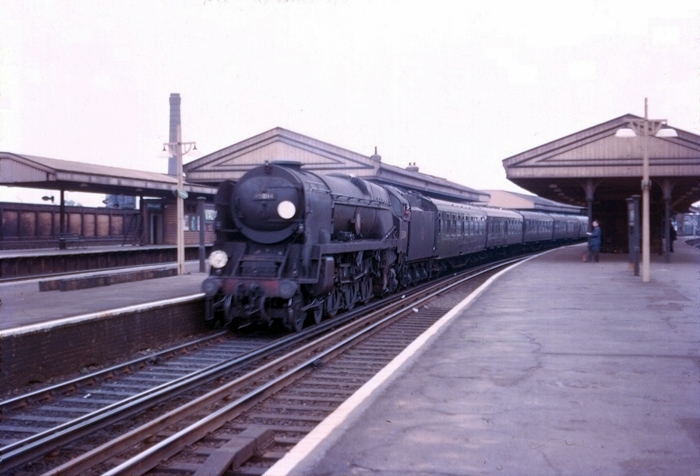
A second view from platform No. 4, but now much further north, better shows the station as a whole. A grubby Rebuilt Merchant Navy Class, No. 35014 ''Nederland Line'', is seen gliding through with another express from Bournemouth, with Bulleid and BR Mk 1 stock in tow. Immediately behind the locomotive, the northern section of platform Nos. 5 and 6's split canopy can be seen, with triangular end piece. On the far left can be seen the island platform commissioned by the Southern Railway in 1936, with prefabricated concrete facing of Exmouth Junction origin. Upon the same platform can also be seen timber offices, whilst in the foreground are the distinctive concrete bracket lampposts with hexagonal shades. © David Glasspool Collection

25th July 2007

The Bulleid Pacifics were long gone by the time of this photograph, but a different type of traffic had been passing the station since November 1994. A once familiar scene at Vauxhall shows a ''Three Capitals'' set on the last leg of its journey, wending its way back to Waterloo. Alongside are domestic units of Classes 444 and 455. © David Glasspool
Return to the Kent Rail Homepage or alternatively, check for Updates.
Website & Copyright information - Links - Contact the Webmaster